viernes, 24 de abril de 2015

LISTENING 


Listening is the other receptive skill as well as reading and likewise it involves the use of context and to have knowledge of the world to understand what is being listened. Listening is about understanding spoken language so as the writing skill, listening also have text types we can be exposed to conversations, stories, announcements, songs, instructions and many others. Listening also involves understanding the different features for example accents and the speeds that people use when they speak and the amount of people talking in a conversation.
We have, or at least try, to process the information as fast as possible because once it is said it disappears immediately


As teachers we can give learners the opportunity to listen to many sources of spoken language which is not that difficult because we constantly are talking to the students however we have to expose students to different speeds of delivery and accents for them to be able to identify phonemes, word stress and sentence stress.


domingo, 19 de abril de 2015

WRITING 


Writing is a productive skill it involves the production of language like the speaking skill but is not the same because for writings documents we have more time to think and organize ideas in order to present a good final job.
During these weeks I have learned so many new aspects of teaching grammar for example some approaches in order to have good results and also I remember the strategies a teacher must follow to teach writing. We have to make students be aware of the degree of formality of the text, and we as teacher take into account the complexity of the text depending on the level, the register and accuracy. Those are aspects that will not be the same in all the levels.

As teachers it is necessary to teach strategies to do a piece of writing; brainstorming for example, and then teach them the steps to develop a writing.


READING


Reading is a receptive skill it involves responding to text and texts are usually longer than just a word or sentence. To understand a text is necessary to have a knowledge of the world to comprehend the connection between sentences.
The  most important aspects of reading involves the different reading skills or sub skills, they help us read in different ways according to our purpose for reading, our reasons for reading influence the way we read. For example if we read a text just to find a specific piece of information then we are scanning, if we read a text to get the general idea of what it is about then we are skimming. Another reading sub skill is reading for detail it involves getting the meaning of every single word, inferring for example is about deducing meaning from context we have to read the words around the unknown word to try to work out its meaning. We do extensive reading when we read for pleasure in contrast of intensive reading which is for academic purposes what in most of the situations is not for pleasure
As teachers in order to teach how read I consider it is imperative to teach vocabulary before handing a piece of reading it will ease the reading process and students will comprehend the texts better, also it is important to take into account the level, age and needs to prepare the lesson.


GRAMMAR


When we talk about grammar we refer to the way we combine, organize and change words and groups of words to make meaning, they could be the different parts of speech that can change in many different ways, some of them contain prefixes others contain suffixes which makes the same word work in different ways. It is also necessary to mention that we use grammar constantly and we do it unconsciously when we speak, read or write and as teacher we use grammar to describe the language´s structure.
There is something called grammatical use, it refers to how grammatical structures are used to convey meaning. A specific grammatical structure do not always work in the same way for any occasion it is important to consider the context in which it is used.

Lastly, the most important field about grammar are the rules, they describe how language works and since language changes over time so the grammatical rules change as well as the language however the books do not update their content so as teacher we have to look for ways to keep updated. 


FUNCTIONS


Every time we speak or write we do it because we have a purpose or a reason to do it and that is the Functions Of Language. When it comes to describe the the functions of language we focus on the use of language and its meaning for the people who are in the context where it is used.

An exponent, the language we use to express a function, can express many different functions at the same time, everything is up to the context it is being used in. Exponents express different levels of formality. Formal language is spoken among people who do not know each other very well. Informal language often occurs among friends in a more relaxing way this type of language is sometimes colloquial. Finally, there is a type of language that is neutral it is a language that may sit in any situation because is not too formal nor informal.


As teachers we might focus on functions in the classroom that can emphasize on communication and learning language chunks. The combination of functions with grammar helps to give grammar meaning and context.


PHONOLOGY

Phonology is the study of the sound features used in a language to communicate meaning, these features include phonemes, word stress, sentence stress and intonation.

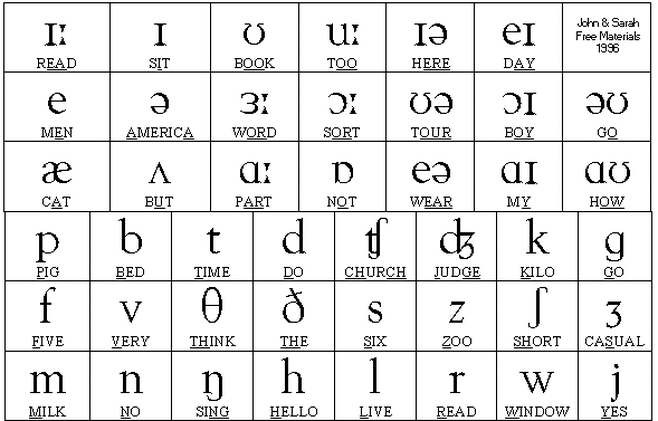
A phoneme is the smallest unit of a sound that can make a difference to meaning in a language. The phonemes of a language are represented in writing by phonemic symbols, each phonemic symbol represents only one phoneme. Phonemic symbols help the reader know exactly what the correct pronunciation is of each word; the phonemes of English are often shown in a chart called the phonemic chart.


Dictionaries always give phonemic transcriptions of words to show their pronunciation, in the transcription of words there is this sign ˡ which is used to show word stress. In English, stress also influences how sentences and groups of words are pronounced this is called sentence stress and it is a characteristic of connected speech.

As teachers it would be very useful that we know perfectly all the phonetic symbols and teach students as many as possible then it will be easier to look a word up in a dictionary and read the correct pronunciation.

LEXIS 


Lexis refers to units of vocabulary which have a specific meaning, words have different types of meaning. A single word can have so many different meaning according to the context.

The meaning of a word may vary for the variations of its forms, for example we can give an opposite meaning by adding a prefix, we can change a word to a comparative o superlative by adding a suffix. This process of adding affixes to the root of a word is called affixation. There are also compound nouns which are two different words with a single meaning
Inside lexis we have collocations they are words that usually, and most of the time, go together, idioms which are fixed expressions so they cannot be changed. The meaning of an idiom can be different from the meaning of the individual words it contain.

As teachers it is worthy to teach words in context instead of isolated because we have seen that words have many different meanings it will be better to let students know in which situation use the correct word.